.svg)

Al-Ahram Newspaper discusses the future of university education and its linkage to the labor market, with the participation of academics and experts
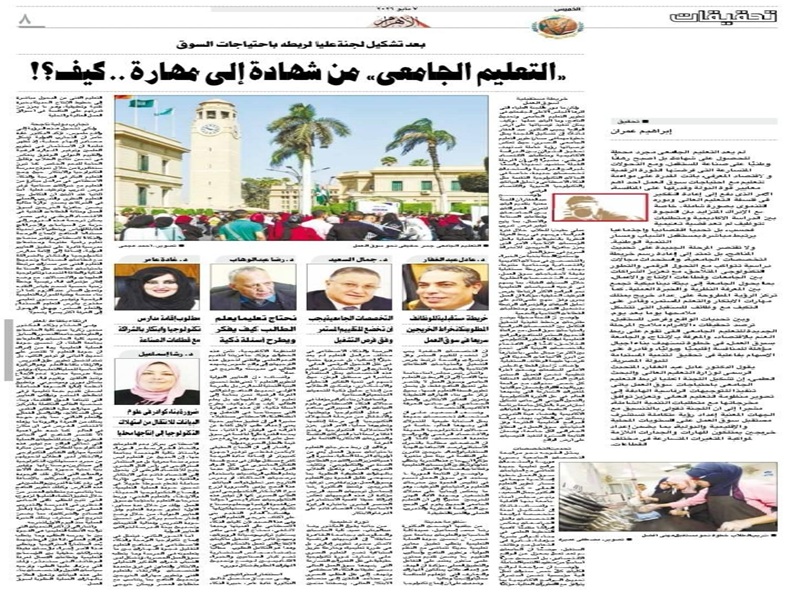
The newspaper “Al-Ahram” addressed in its issue published today, Thursday, May 7, 2026, the topic of the future of university education in Egypt under the title: “University Education: From a Degree to a Skill… How?!”, considering the formation of a high-level committee aimed at linking educational outputs with labor market needs and enhancing graduates’ readiness for future jobs.
Prof. Rasha Ismail, Dean of the Faculty of Computer and Information Sciences at Ain Shams University, emphasized during the investigation the importance of building specialized cadres in data science, stressing the need to move from the stage of consuming technology to producing it locally, in a way that supports the digital economy and enhances competitiveness.
She explained that improving the quality of the educational process requires the application of modern educational standards aligned with international systems, as well as the development of curricula and assessment methods to ensure the delivery of advanced scientific content based on interaction and practical application. She affirmed that the goal is to prepare students who possess the skills and knowledge that qualify them to compete locally, regionally, and globally.
She stressed that integrating programming technology and artificial intelligence across all stages of education is no longer an optional addition but an inevitable necessity considering global digital transformation.
She pointed out that investing in these fields represents a direct investment in the nation’s future, as they contribute to developing analytical and innovative thinking and enabling students to produce smart solutions to societal and industrial challenges.
She added that building qualified cadres in artificial intelligence, data science, and cybersecurity contributes to technology transfer and localization, moving from the stage of technology consumption to the stage of production and development locally, which enhances technological independence and opens wide horizons for startups and innovation-based knowledge projects.
She stated that linking educational outcomes with labor market needs is a top priority at the current stage, noting the importance of strengthening partnerships with the industrial and technological sectors, intensifying practical training, and equipping students with the required applied skills, thereby reducing the gap between education and the labor market and increasing graduates’ employment opportunities.
Dr. Rasha Ismail praised the directives of the President, affirming that these directives reflect a deep awareness of the importance of investing in human capital as the cornerstone of building a knowledge- and innovation-based economy.
For his part, the official spokesperson of the Ministry of Higher Education and Scientific Research, Dr. Adel Abdel Ghaffar, explained that there is a trend toward preparing a future map of required jobs, which will help accelerate the integration of graduates into the labor market. Meanwhile, the Chairman of the Board of Trustees of Benha National University, Dr. Gamal El-Saeed, stressed the necessity of continuously evaluating university disciplines according to employment requirements and available job opportunities.
In the same context, the former Dean of the Faculty of Computer and Information Sciences at Cairo University, Dr. Reda Abdel Wahab, emphasized the importance of developing an educational system that fosters critical thinking and the ability to ask intelligent questions. Meanwhile, Dr. Ghada Amer, AI expert at the Information and Decision Support Center of the Cabinet and Professor of Engineering at Benha University, called for establishing schools for technology and innovation in partnership with industrial sectors, to prepare generations capable of keeping pace with rapid technological developments.
To read the full reportage, click here: