

Ain Shams University Concludes the “SDGs GoGlocal: From Global to Local” Project to Strengthen International Academic Cooperation and Develop Sustainable Solutions to Urban Challenges
As part of efforts to strengthen cooperation between Ain Shams University and its international partners, promote the exchange of academic and research expertise in sustainable development and urban planning, build capacities, develop competencies, and enhance the role of universities in finding innovative solutions to development challenges, the closing event of the “SDGs GoGlocal (2023–2026): Localizing the Sustainable Development Goals – From Global to Local” project was held under the Integrated Urbanism and Sustainable Design (IUSD) program. The project represents a distinguished model of international academic and research cooperation, aiming to bridge global Sustainable Development Goals and local needs through knowledge exchange and scientific research to develop practical solutions that support sustainable community development.
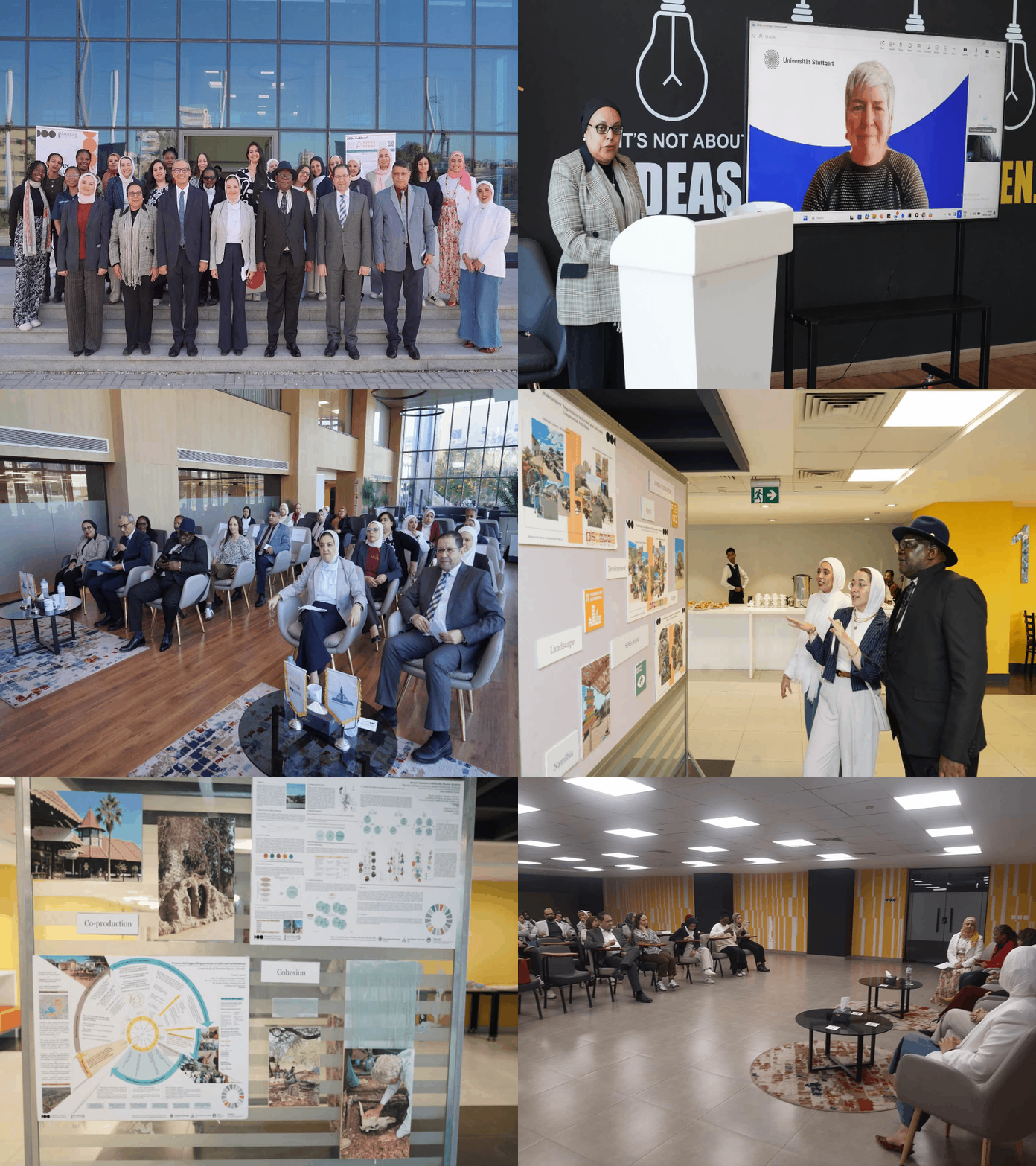
The event was attended by Prof. Amany Osama Kamel, Vice President of Ain Shams University for Postgraduate Studies and Research and Chair of the IUSD Program Board; Prof. Mohamed Salheen, Vice President of Ain Shams National University for Academic Affairs, Advisor to the IUSD Program at Ain Shams University, and Principal Investigator of the project on the Egyptian side; H.E. Ambassador Khaled Aref, Deputy Assistant Minister of Foreign Affairs for African Affairs; H.E. Ambassador Veichem M. U. Mobeas, Ambassador of Namibia; Dr. Sahar Ali, Deputy Director of the German Academic Exchange Service (DAAD) Regional Office in Cairo; Prof. Sherweit El-Ahmady, Executive Director of the International Relations and Academic Cooperation Sector; Prof. Astrid Ley, Director of the IUSD Program at the University of Stuttgart and Principal Investigator of the project on the German side; Dr. Gabi Hansen, from the Namibia University of Science and Technology and Project Director on the Namibian side; Dr. Mirham Klig, Assistant Professor at Ain Shams University and Academic Coordinator of the project; Dr. Marwa Abdel Latif, Director of the IUSD AS Program; and Mr. Mohamed El-Khatib, Assistant Secretary-General of the University for Postgraduate Studies and Research.
Localizing the Sustainable Development Goals Represents a Distinguished Model of Cooperation
Prof. Amany Osama Kamel, Vice President of Ain Shams University for Postgraduate Studies and Research, explained in her speech that the SDGs GoGlocal project represents a distinguished model of international academic and research cooperation, highlighting the importance of cross-border partnerships in translating global Sustainable Development Goals into practical solutions and approaches that respond to the needs of local communities.
She emphasized that Ain Shams University attaches great importance to strengthening academic and research cooperation with African and international universities and scientific institutions, recognizing the role of such partnerships in supporting comprehensive development, capacity building, knowledge exchange, and joint efforts to address development challenges.
She noted that the project, bringing together Ain Shams University, Germany's University of Stuttgart, and the Namibia University of Science and Technology, represents a distinguished example of cooperation between the Global North and Global South. It utilizes education, scientific research, and community engagement to support sustainable urban development and localize the Sustainable Development Goals in ways that reflect the characteristics and needs of local communities.
She stressed that investment in education, scientific research, and human capacity building is a fundamental pillar of sustainable development in Africa, reaffirming Ain Shams University's commitment to expanding partnerships with African and international universities, particularly in sustainable development, innovation, technology, and urban planning, to promote scientific integration and knowledge exchange.
She further emphasized that the project's conclusion marks the beginning of new opportunities for cooperation and partnerships rather than the end of joint efforts, allowing partners to build on its outcomes and maximize its academic and societal impact. She noted that sustainable development requires coordinated visions, collective efforts, and the exchange of expertise among institutions and universities.
Concluding her remarks, she expressed her sincere gratitude to the German Academic Exchange Service (DAAD) and the German Federal Ministry for Economic Cooperation and Development (BMZ) for supporting and funding the project. She also thanked the University of Stuttgart, the Namibia University of Science and Technology, all researchers, faculty members, students, and partners, with special appreciation for the Ain Shams University team and those responsible for the IUSD Program. She reaffirmed the University's continued commitment to international academic and research cooperation and to harnessing knowledge and innovation for the benefit of individuals and society.
The Project Aims to Promote Integrated and Interdisciplinary Educational and Research Approaches
Prof. Mohamed Salheen welcomed the attendees, expressing his pleasure and pride in the academic and research partnership linking Ain Shams University, Germany's University of Stuttgart, and the Namibia University of Science and Technology. He praised the fruitful cooperation among the three universities under the SDGs GoGlocal project, describing it as a model of international collaboration based on knowledge exchange, interdisciplinary integration, and collective action to achieve the Sustainable Development Goals.
He explained that the project aims to promote integrated and interdisciplinary educational and research approaches and prepare professionals capable of leading future urban transformation. This is achieved by systematically and effectively integrating and localizing the Sustainable Development Goals within urban planning and development research and practices, with particular emphasis on informal settlements and underserved communities and on developing mechanisms to address their challenges within higher education and built-environment disciplines.
He noted that the project is based on the importance of adopting an integrated approach to localizing the Sustainable Development Goals, recognizing that urban challenges require cooperation across multiple disciplines rather than reliance on conventional solutions alone. This is particularly relevant in marginalized areas facing limited resources and data, insufficient capacities, weak community participation, and the need for stronger coordination among stakeholders.
He emphasized that focusing on neighborhoods and local communities, involving residents in planning and decision-making, and promoting participatory knowledge production are essential to achieving more inclusive and sustainable urban development, ensuring that proposed solutions are grounded in local realities and capable of generating tangible impact.
He also highlighted the importance of developing databases relevant to local contexts to support scientific research, build an accurate understanding of challenges and needs, and formulate more effective planning policies and practices aligned with the Sustainable Development Goals.
He concluded by emphasizing that the SDGs GoGlocal project represents an important step toward consolidating international academic cooperation, advancing education and scientific research in sustainable urbanism, and preparing a new generation of researchers, planners, and change-makers capable of translating the Sustainable Development Goals into practical applications that serve communities and improve quality of life.
African Solidarity Is a Fundamental Pillar of Egyptian Foreign Policy
Ambassador Khaled Aref, Deputy Assistant Minister of Foreign Affairs for African Affairs, emphasized that African solidarity is a fundamental pillar of Egyptian foreign policy, reflecting the political leadership's vision of strengthening cooperation with African countries, exchanging expertise, and building young people's capacities. He noted that the SDGs GoGlocal project embodies this vision through a trilateral partnership between Egypt, Namibia, and Germany, leveraging academic cooperation to translate the Sustainable Development Goals into practical solutions that serve local communities.
He praised the longstanding academic cooperation between Egypt and Germany and the support provided by the German Academic Exchange Service (DAAD), emphasizing the importance of partnerships between the Global North and Global South in advancing sustainable development, promoting African-led solutions, and connecting education and scientific research with real urban challenges, particularly informal settlements, climate change, and urban governance.
He pointed out that the project had achieved tangible outcomes, including the completion of 12 master's theses addressing the future of urban development in Namibia and the organization of 8 academic exchange visits, highlighting the importance of sustaining this partnership and expanding its prospects.
The Project Benefited Numerous Students, Researchers, and Graduates
The Namibian Ambassador to Cairo stated that the SDGs GoGlocal project represents a genuine model of fruitful cooperation between Namibia, Egypt, and Germany. He noted that the project builds on longstanding relations dating back to Namibia's independence, when Egypt was among the first countries to open its universities to Namibian students.
He explained that numerous students, researchers, and graduates from Namibia, Egypt, and other countries had benefited from the project through training and academic cooperation.
He further explained that Namibia's demographic and resource diversity provides significant opportunities for exchanging expertise and strengthening integration between the two countries. He highlighted differences in aquaculture practices, noting that while Egypt relies on rivers and irrigation canals, Namibia adopts different approaches due to its geographical and coastal characteristics.
He emphasized that sustained development and progress depend primarily on joint scientific research and stronger relations between universities and academic institutions. He expressed hope that the conclusion of the SDGs GoGlocal project would mark the beginning of an expanded partnership and increased opportunities for Namibian beneficiaries and trainees in the future.
Achieving the Sustainable Development Goals Requires Understanding Local Realities and Listening to Communities
Dr. Sahar Ali, Deputy Director of the German Academic Exchange Service (DAAD) Regional Office in Cairo, explained that the event was not merely a celebration of the project's conclusion but also an opportunity to exchange perspectives and assess the partnership's impact. She emphasized the importance of maintaining cooperation and ensuring knowledge transfer beyond the project's official duration.
She noted that achieving the Sustainable Development Goals requires understanding local realities, listening to communities, and developing solutions tailored to each environment, particularly in the African context, where urban challenges, population growth, and environmental pressures must be considered, as no single model can be universally applied.
She emphasized that universities are not merely educational institutions but also spaces for critical thinking and building cross-border academic networks. She highlighted how cooperation among the universities of Stuttgart, Ain Shams, and Namibia demonstrates the success of partnerships in exchanging knowledge and building capacities. She also praised the contributions of students and young researchers from Egypt, Germany, and other countries to fieldwork and action research aimed at addressing real-world problems, noting that such cooperation establishes strong professional and academic networks extending beyond graduation.
She concluded by emphasizing that the project's completion should serve as a starting point for future partnerships and initiatives that strengthen international academic cooperation.
The Project Contributed to Building an Academic Network Connecting Egypt, Germany, and Namibia
Prof. Astrid Ley, Director of the IUSD Program at the University of Stuttgart and Principal Investigator of the project on the German side, expressed her pride in the longstanding academic partnership between Egypt and Germany. She emphasized that the program represents the culmination of years of academic cooperation and exchange, noting that its success would not have been possible without joint funding, institutional support, and mutual trust among the partners.
She expressed appreciation for the support provided by the German Academic Exchange Service (DAAD) and the SDG Partnerships Program, noting that the project had contributed to establishing an academic network connecting Egypt, Germany, and Namibia and strengthening cooperation between the Global North and Global South. This cooperation opens new opportunities for sustaining the partnership and developing future initiatives, particularly by supporting early-career researchers and providing additional educational and research exchange opportunities. She also expressed her aspiration to continue this collaboration beyond the project's completion.
The event featured presentations of master's thesis research addressing the Sustainable Development Goals and informal urban development through case studies conducted in Namibia. Students from Ain Shams University and the Namibia University of Science and Technology participated in these activities between 2024 and 2026, undertaking field research lasting 8 to 10 weeks under joint academic supervision and in cooperation with local partners. These activities helped promote research expertise exchange and comparative analysis of Egyptian and Namibian experiences in sustainable urban development.
On the sidelines of the event, participants reviewed the experiences and knowledge gained throughout the project. One researcher presented the findings of a comparative study between Egypt and Namibia during a panel discussion bringing together project researchers to exchange perspectives, discuss research findings and fieldwork experiences, and maximize the benefits of shared expertise in sustainable urban development.