.svg)

Artificial Intelligence in Service of the Environment: The Faculty of Al-Alsun launches Environment Week with a Seminar on Sustainability and Climate Challenges
As part of Ain Shams University's community role and its commitment to supporting environmental issues and promoting sustainable development within the university community, the Faculty of Al-Alsun launched its Environment Week activities. The event was held under the auspices of Prof. Mohamed Diaa Zain El Abedeen, President of Ain Shams University; Prof. Ghada Farouk, Vice President for Community Service and Environmental Development; and Prof. Yomna Safwat, Acting Dean of the Faculty and Vice Dean for Community Service and Environmental Development.
In her opening remarks, Prof. Yomna Safwat emphasized that organizing Environment Week reflects Ain Shams University's commitment to its academic and community role in raising environmental awareness among students and promoting a culture of preserving natural resources. She noted that the environmental challenges facing the world in light of accelerating climate change necessitate concerted scientific and institutional efforts to disseminate environmental awareness and promote behaviors that support environmental conservation.
She added that the Faculty of Al-Alsun, through these events, is keen to provide a space for scientific and intellectual dialogue on contemporary environmental issues, contributing to raising students' awareness and motivating them to participate in community initiatives aimed at protecting the environment and achieving sustainable development. She emphasized that the university strives to prepare a conscious generation capable of addressing environmental issues and related challenges with a scientific and responsible perspective.
 |
 |
 |
||
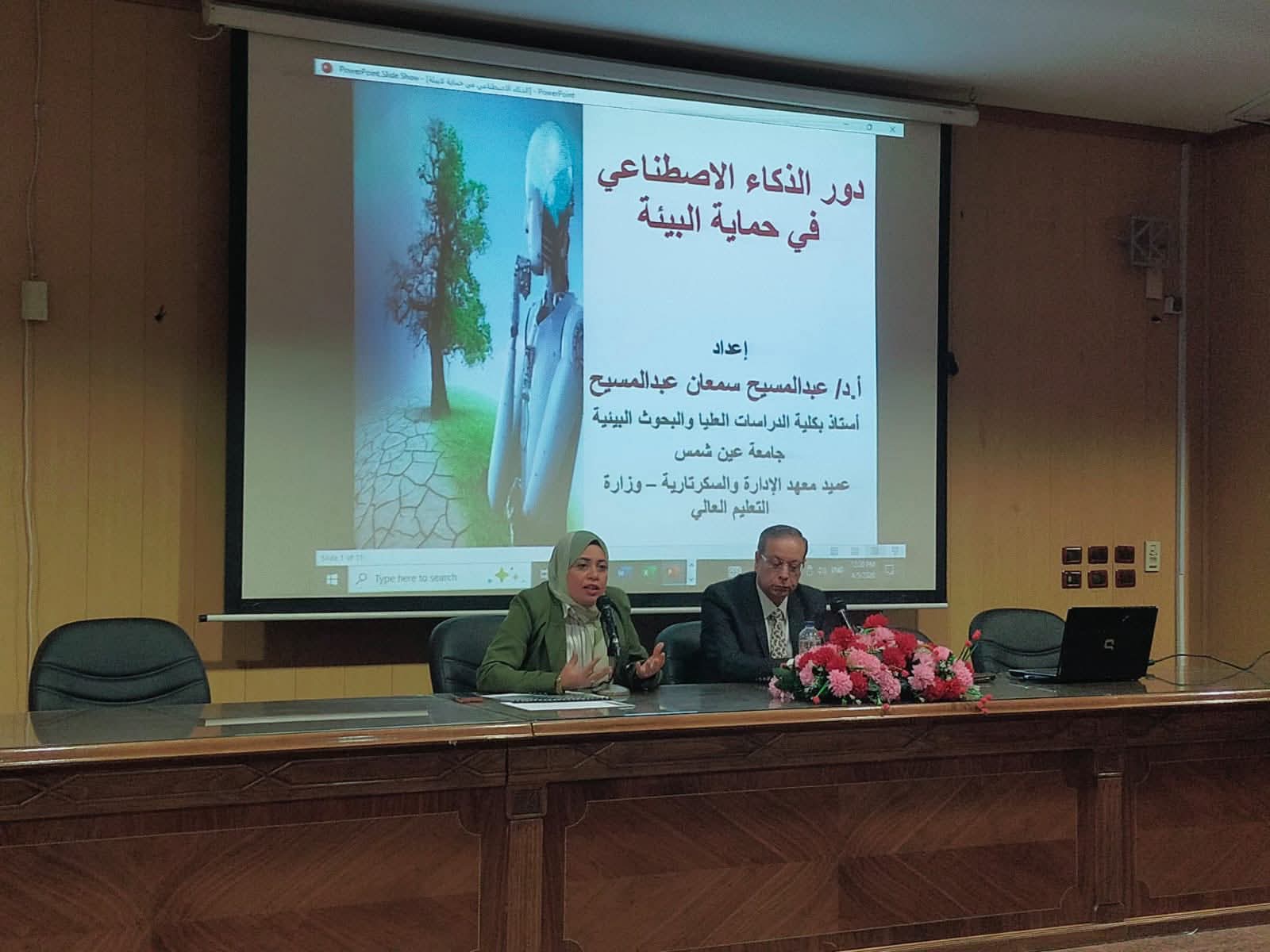
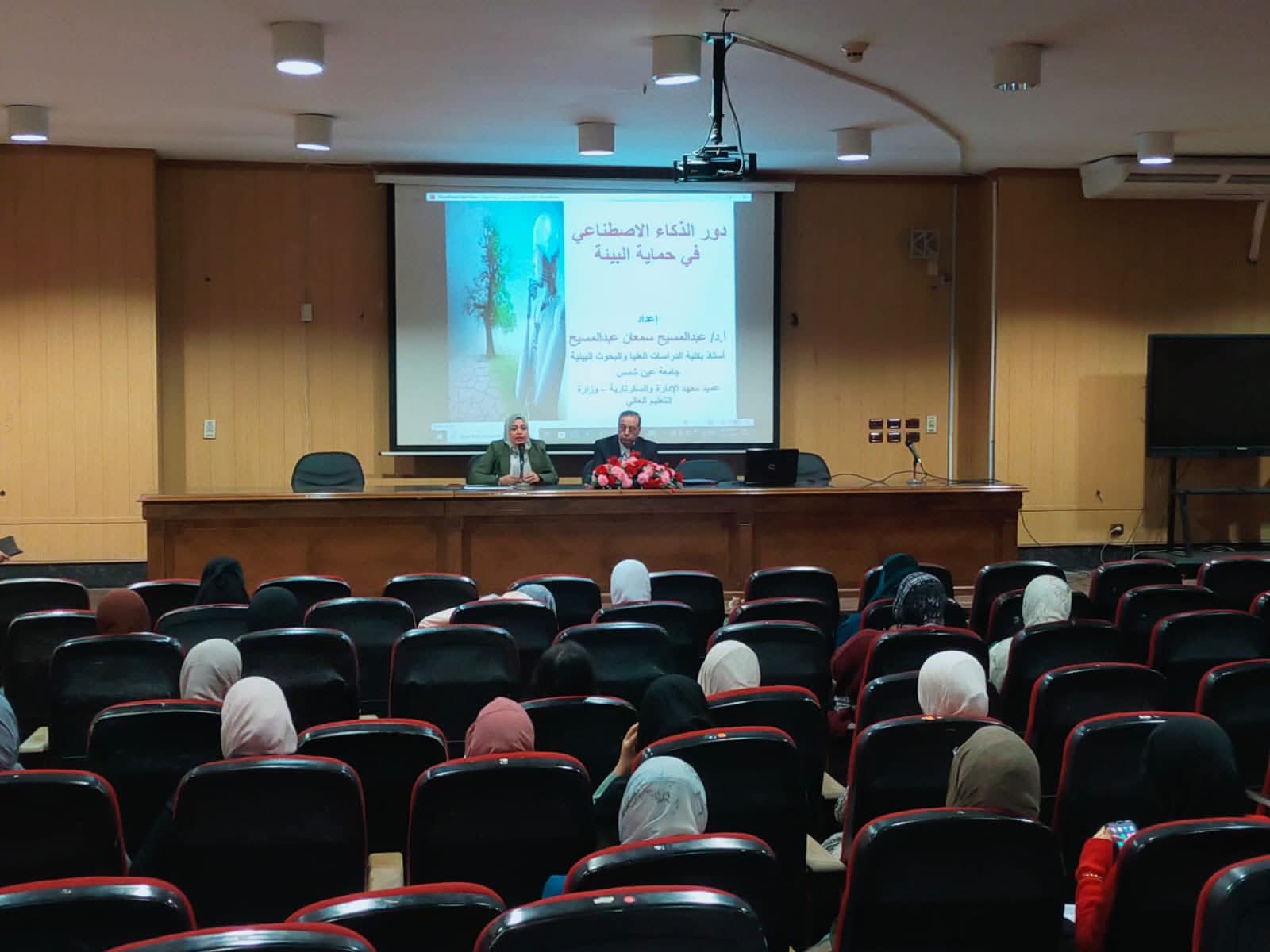
Following the opening remarks, the first event of the week commenced with a seminar entitled "The Environment in the Age of Artificial Intelligence," presented by Prof. Abdel-Messih Semaan, Professor Emeritus at the Faculty of Graduate Studies and Environmental Research at Ain Shams University and a member of the Faculty of Al-Alsun Council. During the seminar, he discussed the growing role of artificial intelligence technologies in supporting environmental efforts and confronting the challenges associated with climate change.
He explained that artificial intelligence (AI) technologies have become an advanced tool for analyzing vast amounts of environmental and climatic data, contributing to a more accurate understanding of climate change patterns and improving climate models used to predict future changes, including temperature forecasts, ice melt, and their impacts on various ecosystems.
He pointed out that AI offers significant potential for predicting natural disasters such as hurricanes, storms, flash floods, and floods, in addition to developing advanced early warning systems for heat waves and droughts. This contributes to reducing human and material losses and enhancing communities' ability to prepare for and cope with these risks.
He also reviewed the role of artificial intelligence in natural resource management, explaining that it contributes to the development of smart agriculture applications by analyzing soil and weather data to improve agricultural production and rationalize resource use, as well as using sensing and image analysis technologies in monitoring forests and tracking deforestation and fires, in addition to developing smart water management systems capable of early detection of leaks, reducing losses and improving the efficiency of water resource use.
He added that artificial intelligence plays a crucial role in monitoring pollution and reducing emissions by analyzing air and water quality and identifying various pollution sources. This enables proactive measures to mitigate their environmental impact. Furthermore, it contributes to improved waste management and recycling processes through the development of smart waste sorting systems using robots, enhancing the efficiency of waste collection and processing, thus supporting the circular economy and reducing waste.
He also emphasized that AI technologies have become an effective tool for reducing the carbon footprint by analyzing and monitoring emissions and providing innovative solutions to mitigate them. In addition, AI plays a role in enhancing energy efficiency and supporting renewable energy sources such as solar and wind power. AI applications help predict energy production rates based on climatic conditions and support smart grids, which balance energy supply and demand and reduce consumption.
The seminar witnessed significant student engagement, with extensive discussions focusing on the future relationship between technology and the environment, and the crucial role of youth in utilizing scientific and technological innovation to address environmental challenges. This fosters their awareness of their responsibility in supporting environmental conservation efforts and achieving sustainable development.
The Environmental Week activities at the Faculty of Al-Alsun reflect Ain Shams University's commitment to organizing scientific and awareness-raising events that enhance students' environmental consciousness and connect academic knowledge with contemporary societal issues. This underscores the university's dedication to preparing graduates capable of contributing to sustainable development and building a more environmentally conscious and balanced future.
The Environment Week of the Faculty of Al-Alsun also featured a handicrafts exhibition alongside a fine arts exhibition inaugurated by Prof. Yumna Safwat. Professor Safwat praised the high quality of the displayed artwork, commending the students for their creative contributions that reflected their cultural and artistic awareness.
The week's activities also included a sports day for students to support student activities and foster a spirit of participation and teamwork. Additionally, a tree-planting campaign was organized within the faculty to raise awareness about the importance of increasing green spaces and their role in improving the university environment, as well as promoting positive environmental behaviors among students.