.svg)


Egypt’s Cabinet Media Center: Aligning Education Outcomes with Labor Market Needs Contributes to Reducing Unemployment Rates
Egypt’s Cabinet Media Center has published several infographics across its social media platforms, highlighting the role of aligning education outcomes with labor market needs in reducing unemployment rates.
This comes within the framework of the state’s direction toward developing the education system and enhancing its quality in a way that strengthens its connection to labor market needs. International indicators have shown a noticeable improvement in the alignment between educational specializations and employment requirements. This approach has contributed to supporting employment opportunities and reducing unemployment rates, particularly among holders of intermediate and higher qualifications, alongside the expansion of modern educational programs, the promotion of scientific research, and the development of educational pathways that keep pace with technological and economic transformations.
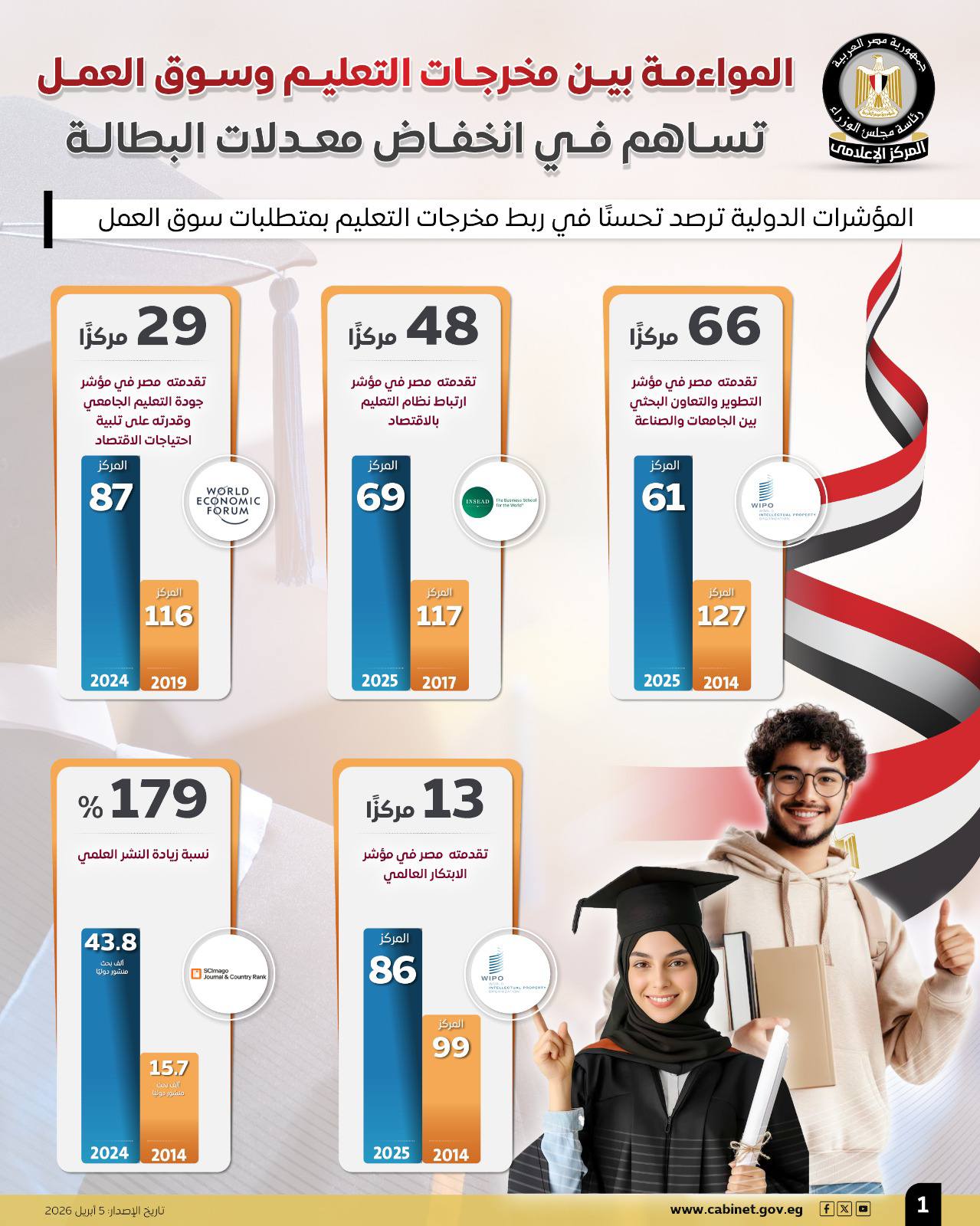
The infographics highlighted improvements in international indicators related to linking education outcomes with labor market demands. Egypt advanced 66 positions in the university–industry research collaboration index issued by the World Intellectual Property Organization, reaching 61st place in 2025 compared to 127th in 2014. Egypt also advanced 48 positions in the education system–economy alignment index issued by INSEAD, reaching 69th place in 2025 compared to 117th in 2017.
The infographics further indicated that Egypt advanced 29 positions in the university education quality and its ability to meet economic needs index issued by the World Economic Forum, reaching 87th place in 2024 compared to 116th in 2019. Egypt also improved its ranking in the Global Innovation Index issued by the World Intellectual Property Organization, reaching 86th place in 2025 compared to 99th in 2014. In addition, scientific publications increased by 179%, according to SCImago, reaching 43.8 thousand internationally published papers in 2024 compared to 15.7 thousand in 2014.
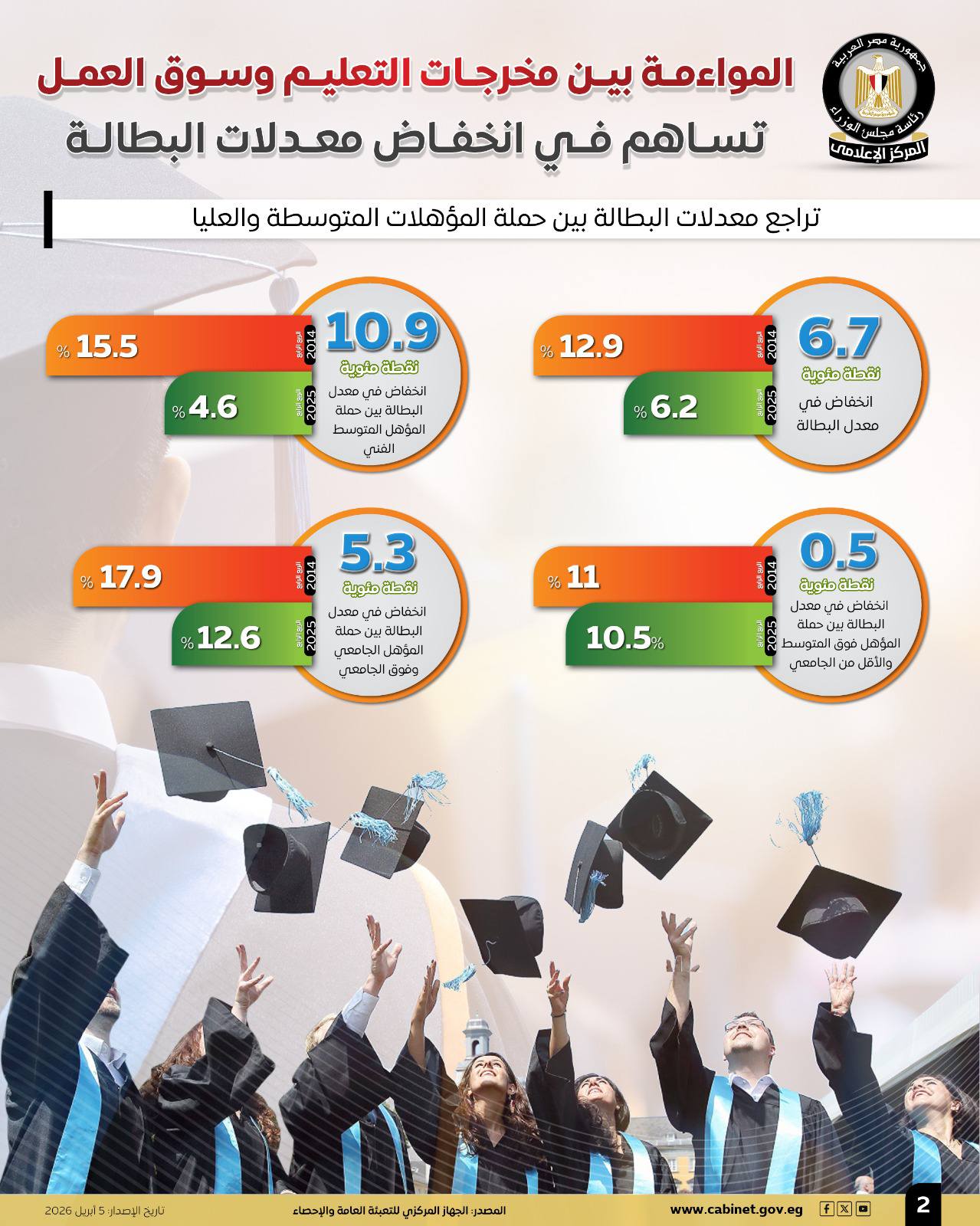
The infographics also highlighted a decline in unemployment rates among holders of intermediate and higher qualifications. The unemployment rate among holders of technical intermediate qualifications decreased by 10.9 percentage points, reaching 4.6% in the fourth quarter of 2025 compared to 15.5% in the fourth quarter of 2014.
Meanwhile, the unemployment rate among holders of above-intermediate and below-university qualifications declined by 0.5 percentage points, reaching 10.5% in the fourth quarter of 2025 compared to 11% in the same quarter of 2014.
The unemployment rate among holders of university and postgraduate degrees decreased by 5.3 percentage points, reaching 12.6% in the fourth quarter of 2025 compared to 17.9% in the fourth quarter of 2014.
Overall, this contributed to a decrease in the total unemployment rate by 6.7 percentage points, reaching 6.2% in the fourth quarter of 2025 compared to 12.9% in the fourth quarter of 2014.
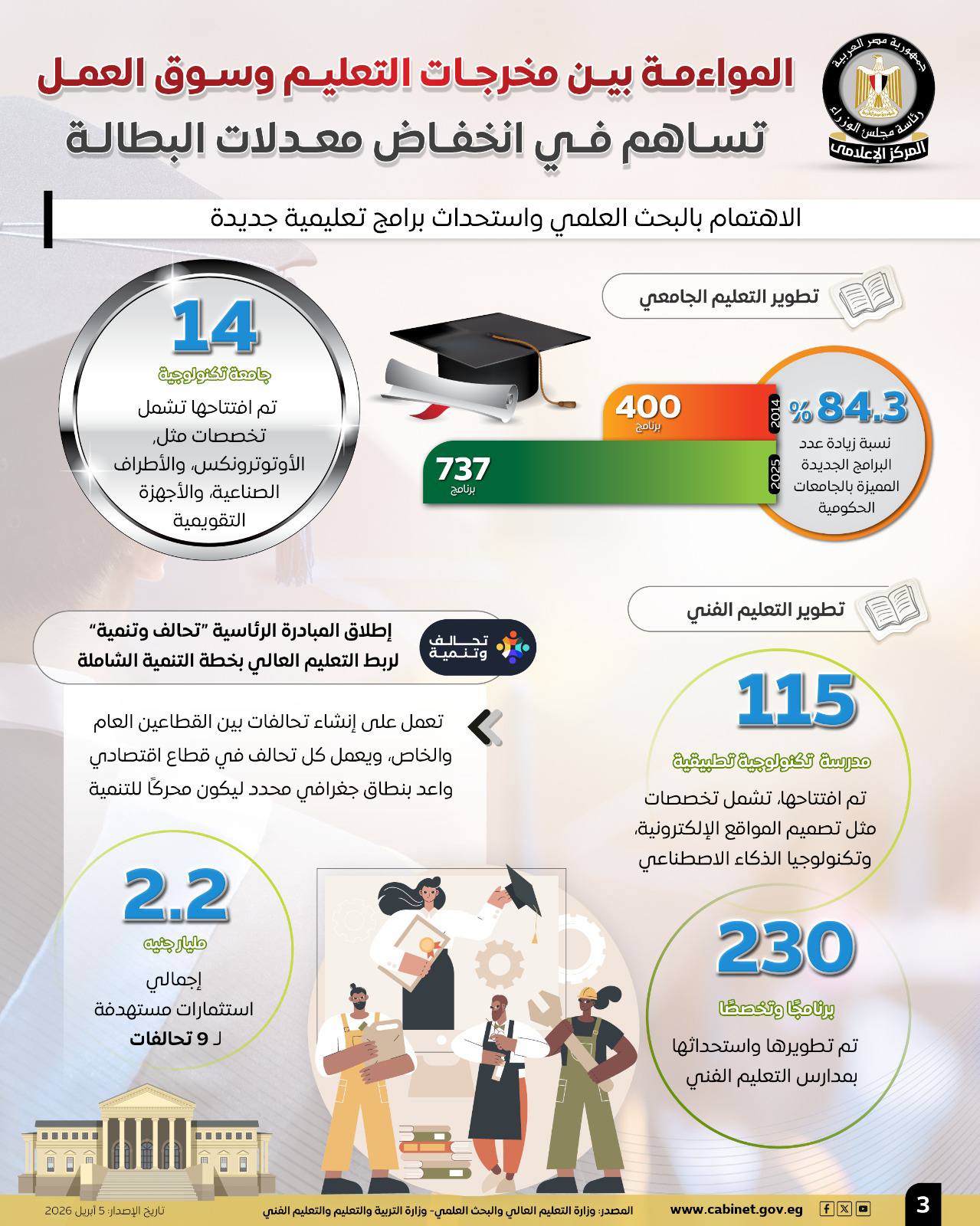
Regarding the focus on scientific research and the introduction of new educational programs, the infographics showed that, in terms of higher education development, the number of distinguished new programs in public universities increased by 84.3%, reaching 737 programs in 2025 compared to 400 programs in 2014.
Additionally, 14 technological universities were established, offering 29 specializations, including autotronix technologies, prosthetics, orthotic devices, mechatronics, and artificial intelligence programs.
As for technical education development, 115 applied technology schools were established in various fields, including website design and artificial intelligence technology, while 230 programs and specializations were developed or introduced in technical education schools.
The infographics also referred to the launch of the presidential initiative “Alliance and Development,” which aims to link higher education with the comprehensive development plan by establishing partnerships between the public and private sectors. Each alliance operates within a promising economic sector in a specific geographic area to serve as a driver of development. The total targeted investments for nine alliances amount to approximately EGP 2.2 billion.
To further strengthen the link between scientific research and industry needs, preparations are underway to launch the “One Professor per Factory” program, which aims to apply researchers’ and innovators’ ideas in practice and transform research outputs into practical industrial solutions.
 |
 |