.svg)


For the fourth consecutive year, Ain Shams University has been ranked among the top 800 universities worldwide according to the Shanghai Ranking 2026
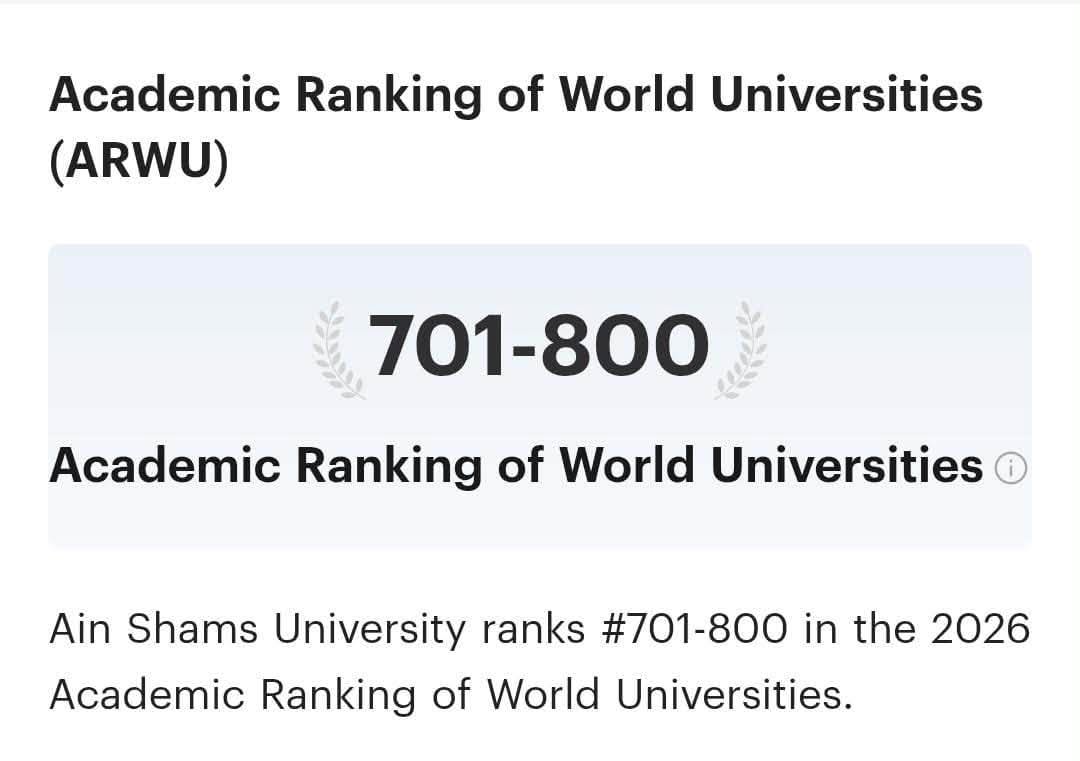
Ain Shams University has maintained its position among the top 800 universities globally, according to the prestigious Shanghai Ranking, achieving a ranking between 701 and 800. This success is attributed to the leadership of Prof. Mohamed Diaa Zain El Abedeen, the President of University.
The university has retained its place in the ranking for the fourth consecutive year since its initial inclusion in 2022, relying on increased international publication indicators. According to the ranking issued in August 2026, Ain Shams University leads Egyptian universities in publications in the prestigious British journal Nature and the American journal Science, two of the world's most distinguished multidisciplinary scientific journals.
Prof. Mohamed Diaa Zain El Abedeen affirms the university administration's commitment to achieving top international rankings and working within a defined university strategy that aligns with the national strategy for advancement in global rankings. He further explained the university administration's ongoing efforts to enhance the quality of collaborative research, aiming for a high number of citations and thus increasing opportunities for publication in high-impact journals.
He added that the 2026 Shanghai Ranking, one of the most prestigious global rankings, placed Ain Shams University in the 701-800 band globally, within the list of the top 1000 universities worldwide, out of 2500 universities included in this year's ranking.
Ain Shams University achieved the highest percentage of research papers published in the journals Nature and Science among Egyptian universities.
The ranking is based on six main indicators: the number of university graduates who have won the Nobel Prize (10%), the number of faculty staff who have won the Nobel Prize and the Fields Medal in Mathematics (20%), the number of highly cited scientists listed in the Clarivate database (20%), the number of research papers published in the journals Nature and Science (20%), the number of research papers indexed in the Science Citation Index – Expanded and the Social Sciences Citation Index (20%), and finally, the academic performance of the individual student at the university. (10%).