.svg)

Higher Education: "Waste Management in Universities" Competition Launched as Part of the "Save It... Illuminate It" Campaign to Support Innovation and Sustainability in Egyptian Universities
In line with the Ministry of Higher Education and Scientific Research's vision to promote sustainability and green transformation within higher education institutions, the Supreme Council of Universities, during its last session, approved the launch of a competition entitled "Waste Management in Universities." This competition falls under the "Save It... Illuminate It" energy conservation campaign, which aims to spread environmental awareness and promote sustainable energy among students in Egyptian universities and institutes, and to transform universities into platforms that support innovative ideas and smart solutions with social and environmental impact.
The competition is held under the patronage of Dr. Abdel Aziz Qansouh, Minister of Higher Education and Scientific Research, and under the supervision of Dr. Karim Hammam, the Minister's Advisor for Student Activities and Director of the Institute for Leadership Development, in cooperation with the Fund for the Care of Innovators and Talented Individuals, under the supervision of Dr. Tamer Hammouda, the Fund's Executive Director. This initiative reflects the Ministry's support for innovative initiatives that aim to connect students' creative ideas with the real-world challenges facing Egyptian society and universities.
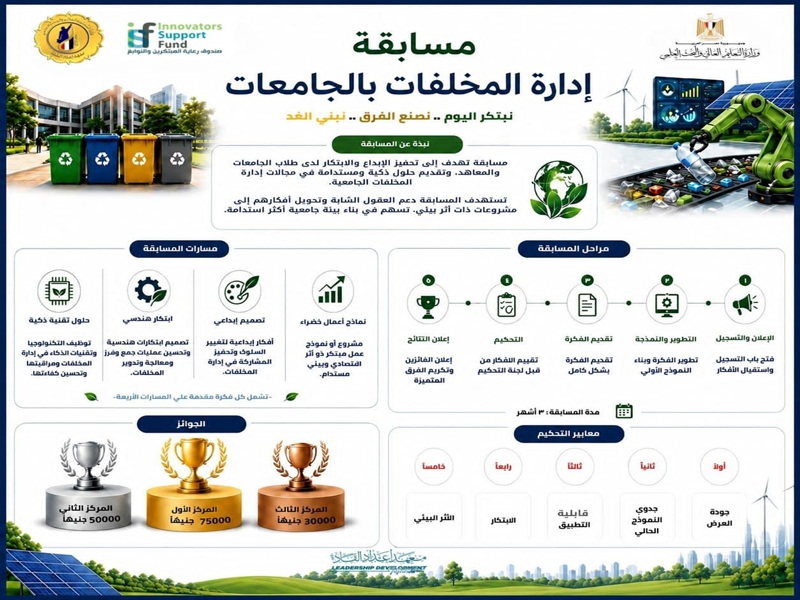
The competition aims to motivate university and institute students to present innovative and sustainable solutions for waste management on campuses. It encourages projects that utilize modern technology, recycling, engineering innovation, creative design, and green economic models, contributing to a more sustainable and efficient university environment and empowering youth to support the Sustainable Development Goals and Egypt's Vision 2030.
The competition includes four main tracks: smart technology, employing modern technologies and artificial intelligence in waste management and efficiency; engineering innovation, developing advanced solutions and systems for collection, sorting, and treatment; creative design, focusing on producing innovative awareness campaigns and ideas to promote positive behavior towards waste management; and green economic models, which aim to present viable projects that achieve both economic returns and environmental sustainability.
The organizing committee has outlined several stages for the competition, beginning with the announcement, opening registration, and receiving ideas. This is followed by an initial evaluation of submitted ideas, then the presentation of the complete idea, the development of prototypes and projects, and finally, the announcement of the results and the awarding of prizes to the winning teams.
The competition is scheduled to run for three months, and the judging criteria will be based on several key areas, including the quality of the presentation, the feasibility of the proposed model, its applicability, its innovativeness, and the potential environmental impact of the idea within the university environment.
In this context, Dr. Tamer Hammouda, Executive Director of the Innovators Support Fund, affirmed that the “University Waste Management” competition represents a model of integration between innovation and sustainability. He added that it contributes to guiding students' ideas toward providing practical and applicable solutions to address environmental challenges within Egyptian universities.
He pointed out that the Fund is keen to support innovative student projects that rely on modern technology and creative ideas, thus contributing to transforming promising ideas into real applications with economic and environmental impact. He emphasized the continued cooperation with the Ministry of Higher Education and Scientific Research in implementing initiatives aimed at building a generation of innovative young people capable of supporting sustainable development efforts and the green transition.
Dr. Karim Hammam, the Minister's Advisor for Student Activities and Director of the Leadership Development Institute, added that the competition comes within the framework of the Ministry's approach to empowering students to actively participate in addressing environmental challenges through innovation and creativity. He pointed out that Egyptian universities possess a wealth of young talent capable of providing real and sustainable solutions that contribute to supporting the state's plans for green transformation and achieving sustainable development.
He emphasized that the Ministry is keen to transform student activities into platforms for generating impactful ideas and initiatives, thereby fostering a spirit of innovation, teamwork, and entrepreneurship among students. He explained that the cooperation with the Innovators Support Fund reflects the integration among state institutions to support talented and innovative individuals, and to provide young people with the opportunity to transform their ideas into viable and scalable projects.
For his part, Dr. Adel Abdel Ghaffar, Media Advisor and Official Spokesperson for the Ministry of Higher Education and Scientific Research, affirmed that launching the competition reflects the Ministry's commitment to instilling a culture of environmental awareness and sustainability within the university community, and to strengthening the role of universities in supporting the state's plans to preserve natural resources and achieve sustainable development.
He explained that the Ministry is working to support initiatives that contribute to raising students' awareness of environmental and social issues, and to encourage them to participate in providing innovative solutions that serve society, thereby enhancing the role of universities as centers of innovation, knowledge creation, and development.
This competition underscores the commitment of the Ministry of Higher Education and Scientific Research and the Supreme Council of Universities to fostering a culture of environmental sustainability within the university community and enhancing the role of universities in supporting innovation and sustainable development. This is achieved by engaging students in developing practical solutions that contribute to preserving natural resources and supporting the green economy.