.svg)

The Middle East Research Center organizes its international conference on regional implications and forecasts the future of the Middle East
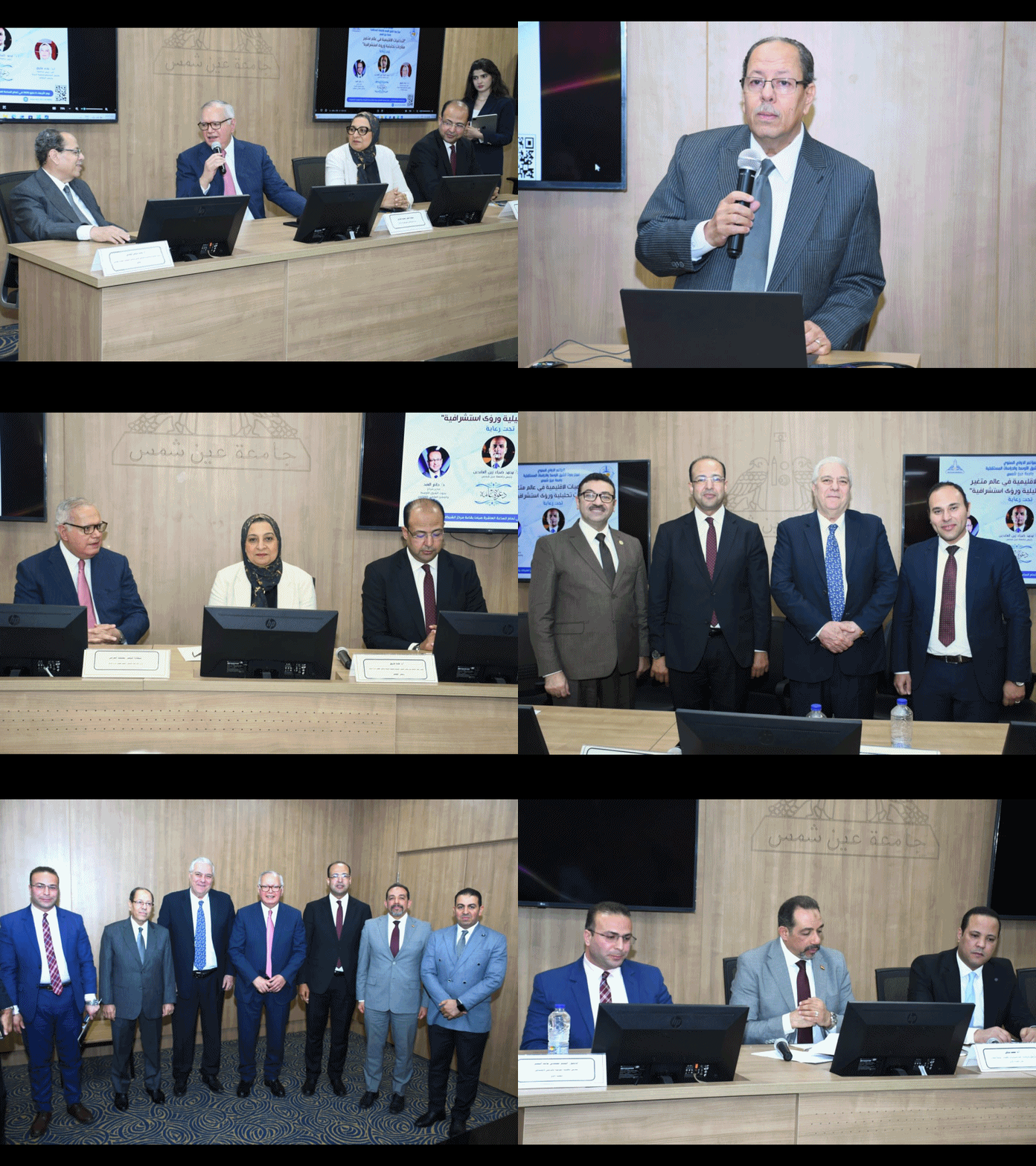
The annual international scientific conference of the Middle East Research and Future Studies Center witnessed remarkable attendance from a distinguished group of scholars, thinkers, and researchers specializing in political and strategic affairs. The event was held at the Information Technology and Networking Center hall, in the presence of Ambassador Mohamed Orabi, former Minister of Foreign Affairs, former Member of the Senate, and member of the Center’s Board of Directors, as well as Prof. Mohamed Shouky El-Anani, Professor of Political Science and International Law and President of the Egyptian Society of International Law.
The age of the law of force and contemporary conflicts
During the opening session, Ambassador Mohamed Orabi emphasized that the current international scene is suffering from a severe shortage of historical leadership capable of containing escalating crises. He noted that the world has effectively entered an era of “the law of power,” which now dominates over the power of international law, amid the weakening of international and regional institutions, which has diminished their ability to maintain global balance and peace.
He explained that contemporary conflicts no longer result in absolute victory or total defeat, but rather end in mutual exhaustion. He stressed that current risks—whether epidemics, wars, or economic crises—are inherently transboundary, and no state, regardless of its power, can isolate itself or confront them alone.
At the regional level, Orabi described the current changes in the Middle East as extremely intense and unprecedented, noting that the region is being reshaped amid complex interconnections. He stressed that the main challenge lies in how to “reconfigure the region” after the current events end, which requires a strategic vision aimed at restoring the concept of the nation-state and filling the power vacuums exploited by destabilizing forces.
He concluded by calling for a new approach to post-crisis management, based on transforming political conflict into developmental and economic cooperation, emphasizing that restoring regional balance depends on building a self-sustaining security framework that prevents external interference and addresses shared challenges collectively, away from bloc politics.
The university's role as a partner in reading and analyzing reality
Prof. Ghada Farouk, Vice President of Ain Shams University for Community Service and Environmental Development and Chair of the Center’s Board of Directors, affirmed that holding the conference under the theme “Regional Implications in a Changing World” comes in response to the rapid transformations taking place globally at both regional and international levels, as well as the increasing intersection between geopolitical dynamics and economic and digital challenges.
She highlighted the pivotal role of Ain Shams University as an active partner in analyzing and interpreting reality, noting that the university seeks through this intellectual platform to foster serious academic dialogue that bridges theoretical analysis and practical application to support decision-makers with informed insights. She also reviewed key topics addressed in the scientific program, particularly geopolitical sovereignty, international waterways security, and the impact of global crises on economic sovereignty.
She emphasized the necessity of addressing national security challenges in the digital age, explaining that threats are no longer traditional but now include information warfare and manipulation of public awareness through digital and media tools. She concluded by stressing the increased responsibility of academic institutions to provide alternative strategic visions that enhance societal stability and adaptability to ongoing changes.
Review of the laws regulating passage through narrow straits
Professor Mohamed Shouky El-Anani, Professor of International Law and President of the Egyptian Society of International Law, stated that the Arab region is currently undergoing one of the most critical turning points in its modern history. He stressed that adherence to internationally agreed-upon rules of international law is not merely a political option but the best and only means to ensure survival and protect state sovereignty amid conflicts that will affect the region for decades across legal, strategic, and economic dimensions.
He called on relevant institutions to adopt decisive recommendations reaffirming the legal status of straits, passages, and international maritime routes. He also emphasized the importance of reviewing regulations governing navigation in narrow straits to safeguard the rights of coastal states and prevent attempts to undermine global maritime security amid regional conflicts.
In a forward-looking vision to address the risks of maritime route closures, he called for developing strategic alternatives to sea straits, particularly through strengthening land transport and railway connectivity projects. He explained that diversifying global trade routes through cross-border land networks would reduce geopolitical pressure on vital waterways and create economic resilience to ensure the flow of goods during major crises.
Monitoring the repercussions, anticipating the future, and shaping it.
Professor Hatem El-Abd, Director of the Center and Scientific Rapporteur of the conference, noted that this event comes at an exceptional time marked by regional fluidity and geopolitical complexity. He emphasized the shift from merely reading the present to anticipating and shaping the future.
He stated that the Center is opening its platform to scholars not only to observe current developments but also to actively participate in forecasting and shaping the future through the use of foresight methodologies in analyzing political and social phenomena, stressing the need to confront cyber threats and information warfare that directly impact national security.
The geopolitics of sovereignty over international waterways
The first session of the conference, titled “Geopolitics of Sovereignty: International Waterways and Economic Policies in a Changing World,” featured rich discussions chaired by Professor Mohamed Salman, Head of the Political Science Department at Cairo University. Dr. Mohamed Abdel Fattah El-Barougy presented on the strategic importance of Egypt and Oman as secure digital corridors amid challenges facing the Strait of Hormuz and Bab El-Mandeb.
The session also discussed the impact of global crises on Egypt’s economic sovereignty through a paper by Dr. Moamen Salah Mohamed, while Dr. El-Bashir Mohamedin addressed criminal liability for violations committed by military and private companies in armed conflicts. The session concluded with Dr. Mohamed Ahmed Zakaria’s study on international responsibility and reparations resulting from state negligence in light of international legal developments.
National security in the digital age
The second session focused on “National Security in the Digital Age: Institutional Governance and Hybrid Threats,” chaired by Professor Hatem El-Abd. It began with researcher Amina Ali Ahmed Tiam discussing the impact of digital transformation on banking financial performance. Dr. Ghada Ahmed Abdel-Mawgoud then addressed the dangers of rumors and information warfare and their direct impact on national security.
Finally, Dr. Neda Imran, Assistant Professor at Al-Nahrain University, examined the role of digital media in shaping public opinion. Dr. Mohamed Farid El-Metwaly, Lecturer of Human Geography at Ain Shams University, presented an analytical perspective on the geography of forced migration and displacement in the Middle East in the 21st century, highlighting its current implications and future scenarios for regional security.
The conference concluded with a set of important recommendations, most notably the need to strengthen strategic foresight tools within sovereign institutions, develop governance frameworks to address hybrid threats, and emphasize the pivotal role of secure digital corridors in supporting the national economy.