.svg)

The Faculty of Al-Alsun organizes its cultural week entitled “History in Literature, Language and Translation”
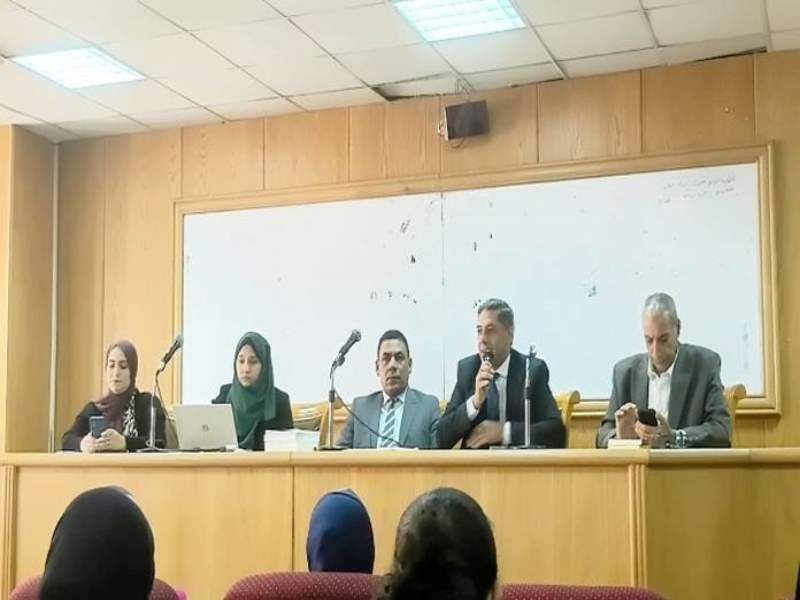
The Cultural Relations Committee of the Graduate Studies Sector at the Faculty of Al-Alsun, Ain Shams University, organized the Faculty's Cultural Week under the theme "History in Literature, Language, and Translation," on Monday and Tuesday, March 30 and 31, 2026. The event was held under the auspices of Prof. Mohamed Diaa Zain El Abedeen, President of Ain Shams University; Prof. Amany Osama Kamel, Vice President for Graduate Studies and Research; Prof. Yumna Safwat, Acting Dean of the Faculty; and under the supervision of Prof. Marwa Mustafa Amin, Head of the Faculty's Cultural Relations Committee.
The Cultural Week was inaugurated by Prof. Ashraf Mohamed Attia, Professor in the Department of Russian Language, who emphasized the close connection between history and the disciplines of the Faculty of Languages, as it intersects with the fields of literature, language, and translation. He pointed to the pivotal role of translation in conveying Egyptian history to the world accurately and faithfully, thus contributing to breaking down its isolation, introducing it to diverse cultures and peoples, and making it accessible.
The first session was chaired by Prof. Fawzi Essa, Assistant Professor Emeritus in the Department of Italian Language, who welcomed the guests and discussed the concept of the historical novel and its differences from the realistic novel. He emphasized the importance of translators adhering to scholarly integrity when rendering historical works, preserving the historical context and the author's vision.
Prof. Hassanin Fahmy, Head of the Department of Chinese Language, spoke about translating historical texts between Chinese and Arabic, highlighting the major challenges facing translators in this field. These challenges include dealing with names of people and places and verifying the accuracy of historical information, given the potential for bias or discrepancies in the narrative of events found in some historical accounts.
Prof. Dalia Hossam, from the Department of French Language, addressed the historical dimension in the novel "Do You Hear the Mountains?" by the Algerian writer Mayssa Bey. She explained the aesthetic features of the narrative style linked to the historical context and emphasized the importance of textual accompaniment in conveying the intended meaning of the original text during the translation process. In the same vein, Dr. Huda Al-Hanawi, a lecturer in the Czech Language Department, reviewed the features of the historical novel in Czech literature, highlighting its most prominent characteristics and key figures. Meanwhile, Dr. Hamida Mahmoud, a lecturer in the Chinese Language Department, discussed the evolution of Chinese translation philosophy from the Han Dynasty to the modern era, noting the early precursors of some modern translation theories within the Chinese intellectual heritage.
Furthermore, Professor Rouhiah Saad, an assistant lecturer in the Japanese Language Department, spoke about Hiroshima literature as a model of human resilience in the aftermath of disasters. She reviewed the historical context in which this literature emerged and highlighted the most prominent literary works that addressed the effects of the atomic bombing and the resulting human tragedies.
The Cultural Week featured three enriching closing sessions. The first session, moderated by Dr. Assem Al-Ammari, a lecturer in the German Language Department, addressed the importance of reading history through dramatic works. This was followed by a joint presentation by Professor Dr. Abdel-Moaty Saleh, former Vice Dean for Education and Student Affairs, and Professor Dr. Sayed Qutb, former Head of the Arabic Language Department. They offered a historical and cultural analysis of the drama "Layali El-Helmiya," considering it a work that embodies the transformations of Egyptian society throughout a historical period spanning from World War II. They noted that the writer Osama Anwar Okasha, through this work, continued the path begun by the renowned writer Naguib Mahfouz in his famous trilogy.
The second session was moderated by Prof. Mohsen Faragany, Professor of Translation in the Chinese Language Department. He began by discussing the history of translation in the Arab world, highlighting the pioneering role of Sheikh Rifa'a al-Tahtawi, founder of the School of Languages, in reviving the Arab-Islamic heritage by launching projects to translate and publish a number of the most important books of Arab heritage at the state's expense at that time. During the same session, novelist and academic Professor Reem Bassiouni, Professor of Sociolinguistics at the American University in Cairo, spoke about reading history through fiction, reviewing her experience in writing several literary works based on historical events, including the "Awlad al-Nas" trilogy about the Mamluks, the "al-Qata'i" trilogy about Ibn Tulun, and the novel "Al-Ghawas Abu Hamid al-Ghazali."
Professor Mona Hamed, Professor of Persian Language and Head of the Department of Oriental Languages at the Faculty, addressed the issue of translation and the rewriting of history through a study of translations of the "Tarikh-i Bayhaqi" (History of Bayhaqi). She pointed to the challenges translators face when dealing with historical texts and some techniques they might employ, such as omission, to guide the reader's understanding of the text.
The cultural week concluded with a session held in cooperation with the Cultural Committee of the Department of Arabic Language, during which the Faculty hosted two professional international translators: Dr. Yasser Shaddad, a translation expert at the United Nations, and Professor Fathi Abdel Raouf, head of the Arabic translation team at the Center for International Law Research and Policy.
The session was opened by Professor Ahmed Abdel-Azim, Professor of Literature and Criticism in the Department of Arabic Language, who emphasized the importance of translators mastering Arabic to the same degree as their specialized language.
In his address, Dr. Yasser Shaddad discussed the topic of professional translation between artificial intelligence and human intervention, clarifying the standards of professional translation in international institutions and the limitations of relying on AI technologies in this field.
Professor Fathi Abdel-Raouf then reviewed the concept of literal translation and the preservation of meaning, presenting practical examples illustrating instances where literal translation contributes to preserving the original meaning of the text, and others where it may lead to its distortion.