.svg)

Under the patronage of the President of the Republic, the Minister of Higher Education announces the results of the “Alliance and Development” initiative
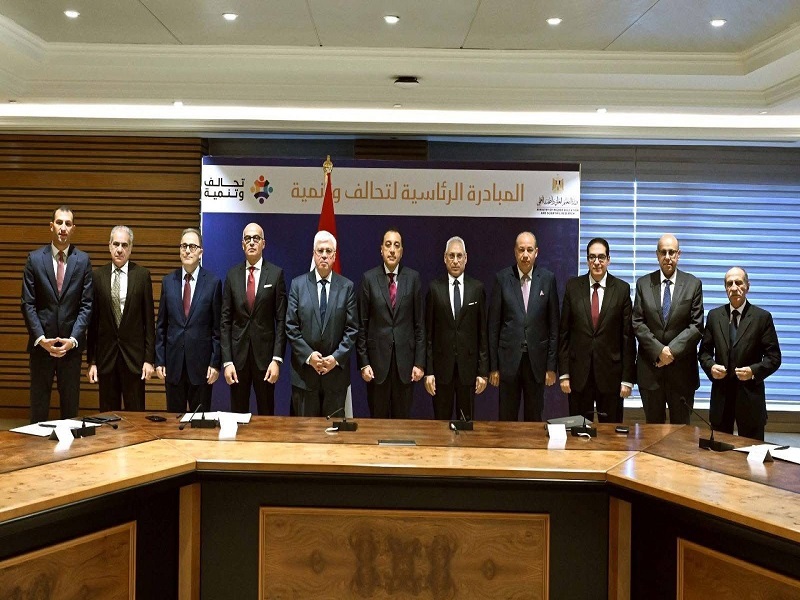
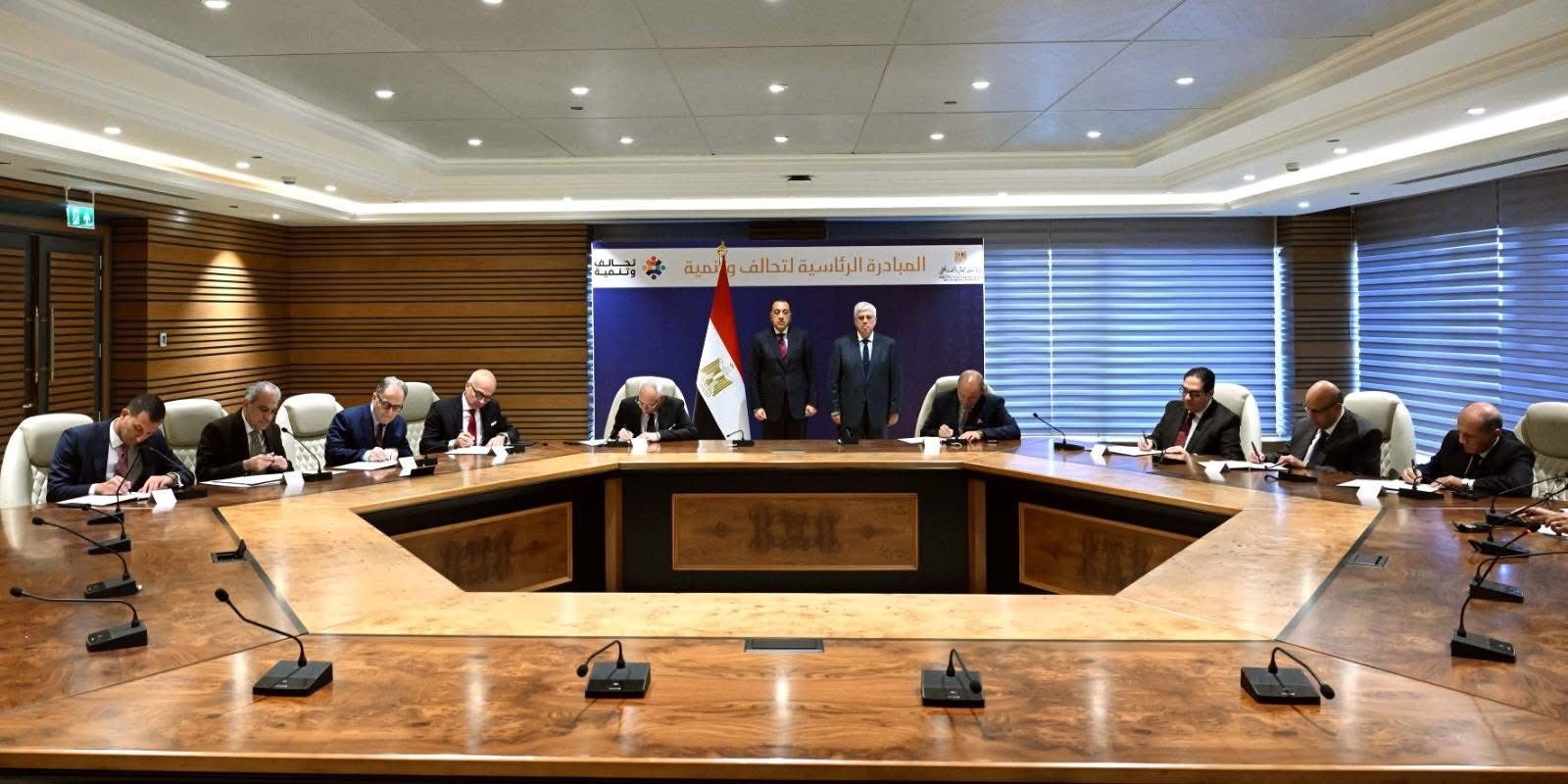
Under the patronage of President Abdel Fattah El-Sisi, President of the Republic, and in the presence of Dr. Mostafa Madbouly, Prime Minister, Dr. Ayman Ashour, Minister of Higher Education and Scientific Research, announced the results of the competition of the presidential initiative “Alliance and Development,” along with the signing of agreements for the winning alliances. This took place on the sidelines of the Tripartite Conference organized by the Ministry of Higher Education and Scientific Research, represented by the Academy of Scientific Research and Technology, at the New Administrative Capital.
The event was attended by Dr. Khaled Abdel Ghaffar, Deputy Prime Minister for Human Development and Minister of Health and Population; Lt. Gen. Kamel El-Wazir, Deputy Prime Minister for Industrial Development and Minister of Industry and Transport; Eng. Mohamed Salah El-Din, Minister of State for Military Production; Dr. Amr Talaat, Minister of Communications and Information Technology; Dr. Mahmoud Esmat, Minister of Electricity and Renewable Energy; Dr. Mohamed Gabr, Minister of Labor; Eng. Mohamed Shimi, Minister of Public Business Sector; Dr. Abdel Majeed Bin Amara, Secretary-General of the Union of Arab Scientific Research Councils; Dr. Margaret Hamburg, Co-Chair of the InterAcademy Partnership; Minister Counselor Maria Michela La Rocchia, Deputy Head of Mission at the Embassy of Italy in Egypt, representing the Italian Ambassador; Dr. Masrisha Vettini, Co-Chair of the InterAcademy Partnership; Dr. Hossam Osman, Deputy Minister of Higher Education for Innovation, Artificial Intelligence, and Scientific Research; Dr. Gina El-Feki, Acting President of the Academy of Scientific Research and Technology; Maj. Gen. Dr. Ashraf El-Beiyoumi, Director of the Military Technical College; Maj. Gen. Mohamed Ahmed El-Laithy, Deputy Director of the Military Academy for the Air Defense College; in addition to a number of former ministers, university presidents, Egyptian and international academic and research leaders, and media representatives.
Both the Prime Minister and the Minister of Higher Education witnessed the signing ceremonies. Dr. Ayman Ashour emphasized that the “Alliance and Development” initiative represents a practical application of the National Policy for Sustainable Innovation 2030, through regional alliances that bring together universities, research centers, industry, and government entities to promote knowledge-based development. He explained that the initiative aims to build strong partnerships that support innovation and entrepreneurship across different regions, transforming alliances into economic engines capable of producing technological solutions and creating job opportunities. He also noted that the Ministry conducted site visits and workshops to introduce institutions to the initiative’s objectives and enhance their readiness to actively participate in the national innovation ecosystem.
The Minister pointed out that the strong turnout reflects broad confidence in the initiative, with 104 alliances applying from various regions, involving 808 members and 553 entities representing diverse sectors, including energy, construction, health, agriculture, education, tourism, and others. This wide participation, he said, demonstrates a genuine desire to transform scientific research into practical tools that serve national development priorities.
Dr. Ayman Ashour further noted that the Ministry allocated EGP 1 billion to support priority innovation areas. The evaluation results led to the selection of 9 alliances comprising 18 universities and research centers, along with 56 industrial institutions, investors, and government entities, implement applied projects capable of creating tangible impact across different regions. He affirmed that the Ministry will closely monitor implementation to ensure the highest developmental and economic returns.
For his part, Dr. Hossam Osman affirmed that the “Alliance and Development” initiative represents one of the largest national programs integrating innovation with industry and entrepreneurship through specialized regional alliances. He explained that the initiative aims to convert research output into practical applications that support the real economy and enhance added value within the regions. He noted that the Ministry adopted a rigorous evaluation system, including detailed meetings with alliances, to select the models most capable of achieving measurable developmental impact and implementable results.
The Deputy Minister added that the final evaluation phase included the development of precise implementation plans for each alliance, covering budgets, performance indicators, and sustainability strategies. He confirmed that each alliance will receive funding ranging from EGP 90 million to EGP 150 million over three years, and that the Ministry will oversee protocol implementation to ensure the initiative’s objectives are achieved and alliances are transformed into effective innovation platforms.
Dr. Adel Abdel Ghaffar, Media Advisor and Official Spokesperson of the Ministry, stated that the competitive call for the “Alliance and Development” initiative, launched on February 17, 2025, falls within the implementation of the National Strategy for Higher Education and Scientific Research 2030. He noted that the Ministry organized meetings and workshops across various regions to support alliance formation. A total of 104 alliances applied, and 9 alliances were selected based on precise evaluation mechanisms covering technical and implementation aspects, in line with the state’s vision to build an innovative knowledge-based society that supports inclusive growth and enhances the competitiveness of the Egyptian economy.
In the Greater Cairo Region, an alliance led by Ain Shams University, comprising 8 members, was selected. The alliance focuses on the production of sustainable animal feed using biotechnology and renewable energy to support food security through the recycling of agricultural waste and food processing by-products.
Another winning alliance represented by Cairo University, comprising 7 members, aims to enhance the institutional transformation of universities toward innovation and entrepreneurship, relying on artificial intelligence applications and the digital economy.
The region also included an alliance led by the American University in Cairo, comprising 9 members, which focuses on developing the semiconductor and microelectronics design sector to enhance competitiveness and attract investments. In addition, an alliance represented by Zewail City of Science and Technology, comprising 7 members, aims to localize the manufacturing of reference pharmaceutical materials and build national expertise to support drug security.
In the Alexandria Region, an alliance led by Alexandria University, comprising 7 members, was selected. It focuses on strengthening the electric vehicle industry and smart transportation by increasing local content and qualifying human resources.
As for the Delta Region, it included an alliance led by Mansoura University, comprising 12 members, focusing on developing a smart dairy industry system with the aim of improving quality, supporting food security, and increasing exports.
In the Suez Canal Region, an alliance led by Suez University, comprising 10 members, was selected. The alliance focuses on advanced industries and smart logistics to maximize the economic benefits of the Suez Canal corridor and support the transition toward a knowledge-based economy.
In the Upper Egypt Regions, an alliance led by Minya University, comprising 5 members, was selected. It focuses on smart agriculture technologies to increase productivity and reduce water waste using modern technologies.
Another alliance led by Aswan University, comprising 9 members, was also selected. It focuses on the local manufacturing of renewable energy technology components, workforce qualifications, and the establishment of specialized laboratories, contributing to reducing imports and boosting exports.