


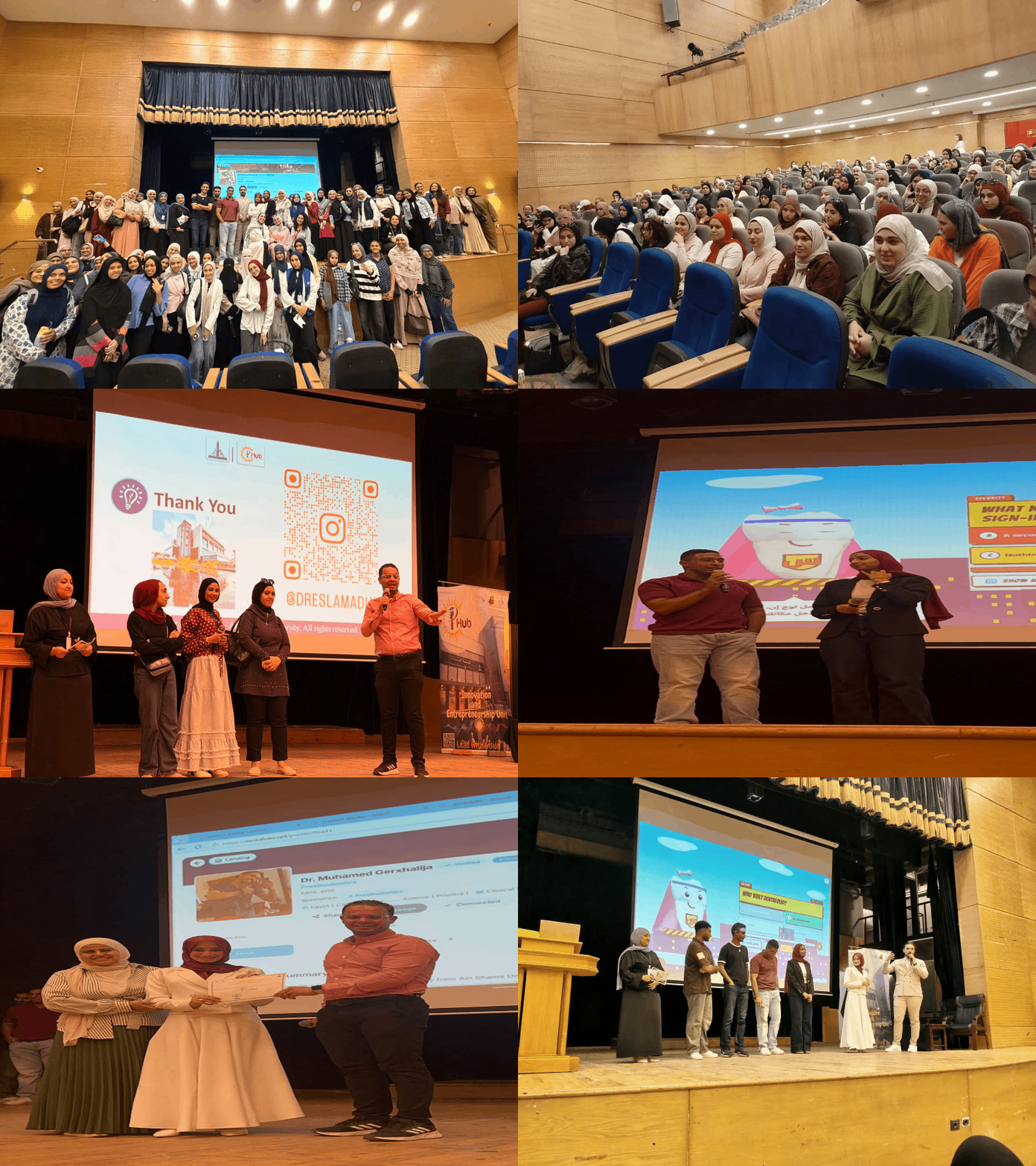
From Idea to Investment… “Innovation Day” at the Faculty of Women Opens New Horizons for Entrepreneurship and the Knowledge Economy in Collaboration with the (iHub) Center
In a move reflecting Ain Shams University's commitment to fostering a culture of innovation and entrepreneurship and maximizing the contribution of scientific research outcomes to the knowledge-based economy, the Innovation and Entrepreneurship Unit at the Faculty of Women for Arts, Science and Education organized Innovation Day in collaboration with the University's Innovation and Entrepreneurship Center (ASU-iHub). The event was held as part of the University's strategy to empower students and researchers to transform their creative ideas into practical projects and startups that generate economic and social value.
The event was held under the patronage of Prof. Mohamed Diaa Zain El-Abedeen, President of Ain Shams University, and Prof. Amany Osama Kamel, Vice President for Postgraduate Studies and Research, and under the supervision of Prof. Neveen Assem, Executive Director of the University's Innovation and Training Sector; Prof. Mohamed Kaheel, representative of the University's Innovation and Entrepreneurship Center; Assoc. Prof. Islam Adly, Director of the University's Innovation Clubs Project; Prof. Amira Ahmed Youssef, Dean of the Faculty of Women for Arts, Science and Education; Prof. Heba Barakat, Vice Dean for Community Service and Environmental Development; Prof. Asmaa Zaazaa, Vice Dean for Education and Student Affairs; and Dr. Aya Rady, Director of the Faculty's Innovation and Entrepreneurship Unit.
Prof. Amira Ahmed Youssef, Dean of the Faculty, expressed her appreciation for the efforts of the University's Innovation and Entrepreneurship Center in supporting the innovation ecosystem. She emphasized the importance of making the Center's services and resources accessible to students, researchers, and faculty staff, opening new opportunities for them to develop their scientific ideas and transform them into innovative, applicable projects.
She also praised the efforts of the Faculty's Innovation and Entrepreneurship Unit in promoting a culture of innovation, activating its activities, and strengthening communication with various University faculties. These efforts contribute to creating a university environment that supports creativity and connects academic knowledge with community needs and development requirements.
The event featured a specialized workshop on the role of Ain Shams University's Innovation and Entrepreneurship Center in stimulating innovation and enabling researchers to capitalize on their research ideas and transform them into practical projects with commercial potential.
During the workshop, Assoc. Prof. Islam Adly, Assistant Professor at the Faculty of Science and Director of the Innovation Clubs Project (iClub), reviewed the support mechanisms provided by the Center to innovators and researchers. He highlighted its role in developing scientific ideas and transforming them into business models and entrepreneurial ventures capable of competing and generating economic and social value.
He also discussed the Center's efforts to build the capabilities of innovators through specialized training camps, business model development, connections with supporting organizations, incubation of promising projects, and the provision of technical and financial support to help these ventures grow and achieve sustainability.
As part of the presentation of the University's specialized innovation initiatives, the workshop highlighted the Innovation and Training Sector's project, GEMS-Tech – Green Maritime Horizons: Collaborative Innovation in Ship Engineering and Sustainable Technologies, funded by the European Union under the Erasmus+ Capacity Building in Higher Education (CBHE) program.
The project aims to support innovation in ship engineering and sustainable technologies and promote the transition toward green maritime practices by developing academic and technological capabilities and upgrading educational and training infrastructure.
Participants were also introduced to the advanced technological capabilities of the laboratory established under the project, which is equipped with 3D printing, laser cutting, 3D scanning, and virtual reality technologies, as well as air quality and noise measurement devices. These facilities enable researchers to design, manufacture, and test prototypes, transforming research ideas from theoretical concepts into tangible innovative applications.
To connect theoretical knowledge with practical experience, the event featured two inspiring entrepreneurial success stories presented by the founders of Dentafolio and Wedja Solutions. They shared their journeys of learning and innovation and the challenges they encountered while transforming initial ideas into real projects capable of implementation and further development.
The two experiences highlighted an outstanding model of collaboration between the University's Innovation and Entrepreneurship Center and the Faculties of Dentistry and Computers and Information. The integration of medical and technological expertise, combined with the support and guidance provided by the University's innovation ecosystem, contributed to developing and refining ideas and transforming them into practical projects. This demonstrated the importance of interdisciplinary collaboration in creating innovative solutions and promising entrepreneurial opportunities.
The founders explained that the success of an idea depends not only on its originality but also on the ability to develop it, identify market needs, draw on multidisciplinary expertise, and work collaboratively to transform it into practical solutions that deliver added value.
Participants emphasized that entrepreneurship is not limited to any academic discipline. Rather, it depends on the ability to identify challenges, think creatively, apply acquired knowledge and skills, and work as a team to develop solutions that respond to community needs.
The founders of the two projects delivered an inspiring message to students, encouraging them to make the most of their university years by learning, experimenting, and acquiring new skills rather than waiting for ideal circumstances to begin. They emphasized that successful ventures could emerge from simple ideas that evolve through determination, hard work, and continuous learning. They also highlighted that the university environment, with its expertise, resources, and partnerships, provides a valuable starting point for establishing successful entrepreneurial ventures.
Innovation Day concluded with an open discussion session addressing attendees' questions about opportunities and mechanisms for supporting innovation and entrepreneurship within the University. The session emphasized the importance of continuing to organize awareness-raising and training activities targeting students, researchers, and faculty staff.