.svg)

Chinese Writers Association Launches First Chinese Cultural Initiative in Egypt Following President Xi Jinping’s Visit: “Chinese Literature Readers Club in Egypt” Inaugurated at the Faculty of Al-Alsun
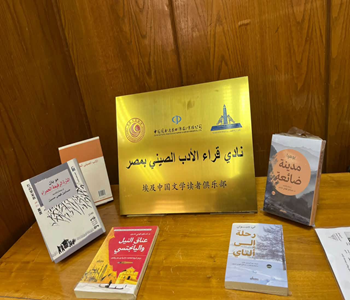
Under the patronage of Prof. Mohamed Diaa Zain El-Abedeen, President of Ain Shams University, Prof. Youmna Safwat, Dean of the Faculty of Al-Alsun at Ain Shams University, received a delegation from the Chinese Writers Association and the China National Publications Import & Export Corporation on the occasion of the inauguration of the “Chinese Literature Readers Club in Egypt” at the Faculty’s Department of Chinese Language. Launched by the Chinese Writers Association in cooperation with the China National Publications Import & Export Corporation, the initiative selected the Department of Chinese Language at Ain Shams University as its headquarters, marking the first implementation of a Chinese cultural initiative in Egypt following Chinese President Xi Jinping’s significant visit to Egypt earlier this September.
 |
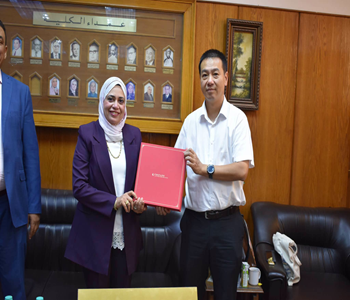 |
The inauguration ceremony was attended by Prof. Hassanein Fahmy Hussein, Head of the Department of Chinese Language and Supervisor of the “Chinese Literature Readers Club in Egypt”; Mr. Jing Liyi, Deputy Director of the International Cooperation Office of the Chinese Writers Association; Mr. Huajun Ming, poet, short-story writer, and Deputy Editor-in-Chief of Poetry Magazine in China; and writer Guo Xuanbo, Deputy Dean of the Shanxi Institute of Literature. Also attending were Egyptian poet Dr. Marwa Nabil, writer and critic Mounir Oteiba, and writer Saad El-Qersh, along with a large gathering of professors, faculty members, teaching assistants, and researchers from the Department of Chinese Language at the Faculty of Al-Alsun.
Prof. Youmna Safwat welcomed the Chinese delegation, emphasizing the deep-rooted academic and cultural ties between the Faculty of Al-Alsun, represented by its Department of Chinese Language, and the Chinese side. She highlighted the prominent role played by the Department’s faculty members and graduates in studying, translating, and introducing Chinese literature to audiences in Egypt and the Arab world. She noted that selecting the Department of Chinese Language at the Faculty of Al-Alsun as the Club’s headquarters reflects the Department’s distinguished academic and cultural standing and its longstanding role in building bridges of communication between Egyptian and Chinese cultures.
The Dean emphasized that the inauguration of the “Chinese Literature Readers Club in Egypt” represents an important addition to Egyptian Chinese cultural cooperation and provides a specialized platform for dialogue and interaction among writers, creative professionals, researchers, and translators from both countries, particularly amid the significant development in Egyptian Chinese relations across various fields and the expanding horizons of cultural cooperation.
For his part, Mr. Jing Liyi, Deputy Director of the International Cooperation Office of the Chinese Writers Association, conveyed the Association President’s greetings to Prof. Youmna Safwat and thanked the Faculty of Al-Alsun for hosting the Club. He highlighted the strong and distinguished relations between the Chinese Writers Association and faculty members of the Department of Chinese Language, recognizing their important role in introducing Chinese literature to audiences in Egypt and the Arab world.
He explained that the Chinese Writers Association was keen to select the Department of Chinese Language at Ain Shams University as the headquarters of the “Chinese Literature Readers Club in Egypt” in recognition of its distinguished academic standing. He also highlighted the selection of Prof. Hassanein Fahmy Hussein, one of the most prominent researchers and translators of Chinese literature in Egypt and the Arab world, to supervise the Club.
The Deputy Director of the International Cooperation Office of the Chinese Writers Association emphasized that the inauguration of the Club marks the first implementation of a Chinese cultural initiative in Egypt following Chinese President Xi Jinping’s significant visit to Egypt earlier this September. He noted that the Association is developing a comprehensive program of activities to be implemented through the Club in cooperation with the Department of Chinese Language at Ain Shams University.
He explained that upcoming activities will include seminars and meetings bringing together Chinese writers and creative professionals with their Egyptian counterparts, as well as Egyptian researchers and translators specializing in Chinese literature. Egyptian translators and researchers will also be given opportunities to participate in events and conferences organized by the Chinese Writers Association in China, further strengthening literary and cultural exchange between the two countries.
Prof. Hassanein Fahmy Hussein, Head of the Department of Chinese Language and Supervisor of the “Chinese Literature Readers Club in Egypt,” expressed his delight at the Club’s inauguration and thanked Prof. Youmna Safwat, Dean of the Faculty, for her strong support for its establishment and her commitment to strengthening the cultural and academic role of the Department of Chinese Language.
He noted that, in cooperation with the Chinese Writers Association, the Club will develop future featuring a diverse range of literary and cultural activities, including seminars, workshops, creative writing workshops, and regular meetings between Chinese writers and Egyptian researchers and translators specializing in Chinese literature.
Following the inauguration ceremony, the Club launched its first event under the title “Meeting of Civilizations: An Egyptian Chinese Literary Dialogue,” with the participation of the Chinese delegation, Egyptian writers, faculty members, teaching assistants, researchers, and translators specializing in Chinese literature.
The session featured rich dialogue and in-depth discussions among Egyptian poet Dr. Marwa Nabil, writer and critic Mounir Oteiba, writer Saad El-Qersh, and members of the Chinese delegation. Discussions addressed literary creativity, Egyptian Chinese literary and cultural exchange, the history and development of Chinese poetry in the modern era, and the importance of strengthening communication between writers and intellectuals in both countries.
Participants also discussed the importance of expanding literary and cultural exchange between Egypt and China and overcoming the effects of Eurocentrism, which for many years influenced Egyptian writers’ and intellectuals’ exposure to literary experiences from the East, as well as Chinese writers’ and intellectuals’ engagement with Egyptian and Arab literature. They stressed the importance of creating broader spaces for dialogue between the two cultures.
Participants highlighted the emergence in recent years of new generations of Egyptian translators specializing in Chinese, who have enriched the Arabic library with significant works translated directly from Chinese into Arabic. This reflects the growing interest in Chinese literature in Egypt and the Arab world and underscores the importance of the “Chinese Literature Readers Club in Egypt” as a sustainable platform for strengthening literary and intellectual dialogue between Egypt and China.